
For Muslim parents who want to homeschool without sacrificing faith, peace, or academic confidence
How Muslim Homeschooling Becomes Sustainable When the Day Is Built Around Prayer, Not the Clock
So you can stop restarting schedules, stop choosing between Quran and academics, and finally experience consistency without burnout
30-Day Money-Back Guarantee · Instant Digital Access

The Struggle Is Real
You didn't leave the system
to recreate it at home
You didn't leave the system to recreate it at home
You chose homeschooling because the values no longer aligned. What your children were being taught conflicted with what you were teaching at home.
Ideas about identity, morality, and purpose required constant correction.
Islam felt like something you had to defend rather than something shaping the day.
So you stepped away from the modern education system.
That decision brought relief.
It also created uncertainty.
Once you remove secular schooling, you still need a structure that works for Muslim life.
If you are new to homeschooling, the questions come fast.
Where do you begin?
How do you teach well without recreating the same framework you just left?
If you have been homeschooling already, the pattern is familiar.
You plan carefully.
You adjust the schedule.
By midweek, it falls apart.
The real problem is not effort or sincerity. It is misalignment.
Most homeschooling frameworks are built on assumptions that do not fit Muslim family life.
They assume the day belongs to the clock
They treat prayer as an interruption
They separate Islamic education from “real school.”
They reward rigid consistency and punish flexibility
Introducing The Prayer Anchored Homeschool. A 7 day framework built to help muslim parents move from chaotic, guilt-driven homeschooling to a calm, faith integrated system that holds steady through real life.
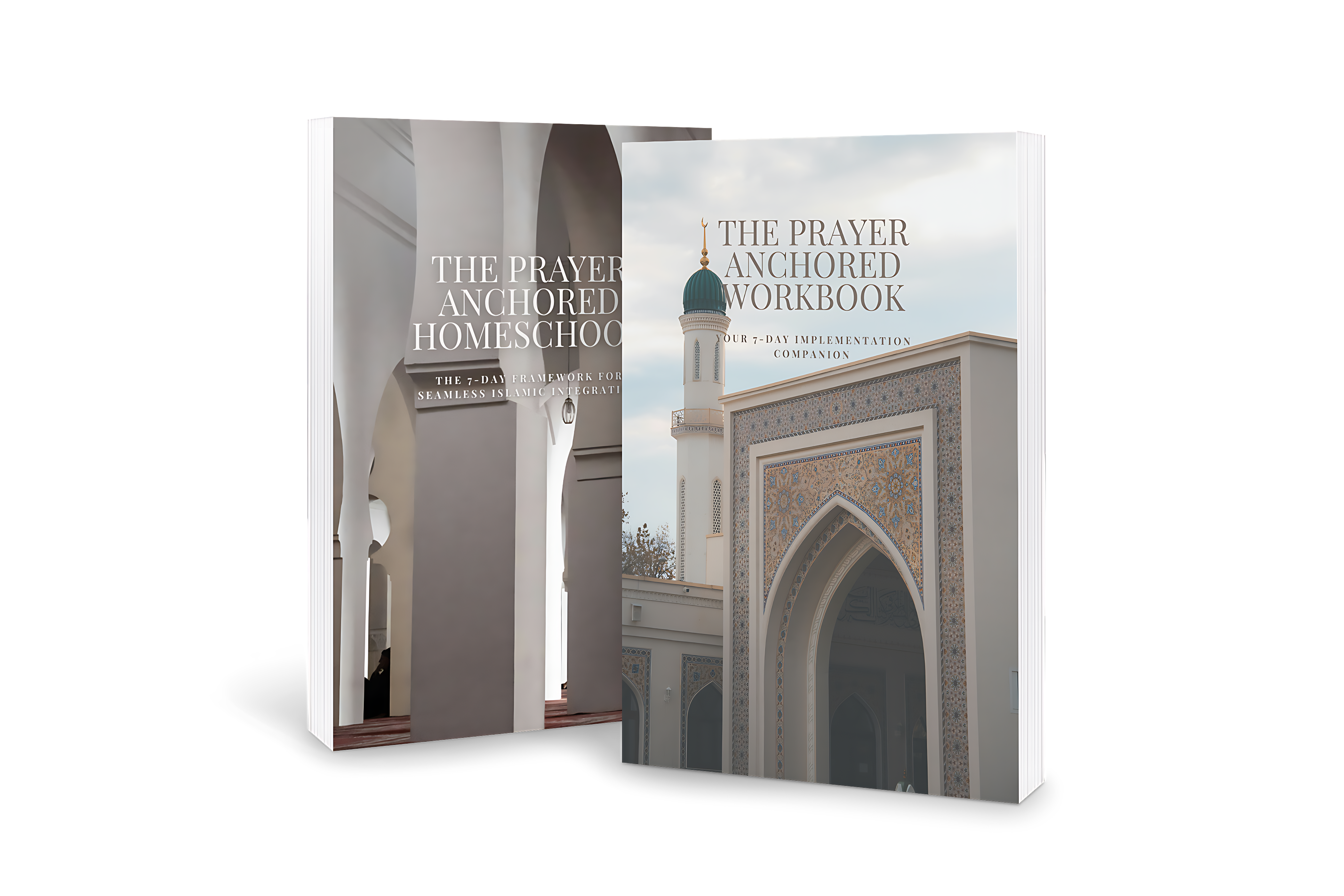
The Prayer-Anchored Homeschool is a complete digital framework for Muslim parents who want to homeschool their children in a way that genuinely reflects Islamic life and not a secular system with Islam added on top.
It is a 7-day guided process that takes you from wherever you are right now. Overwhelmed, inconsistent, or just starting out, to having a fully built,personalized homeschool system that is grounded in your faith, realistic about your life, and designed to last.
The framework uses the five daily prayers as the natural structure of the school day, dividing learning into four purposeful blocks that shift with the seasons automatically. Islam is not a separate subject slotted into the timetable. It becomes the lens through which every subject is taught.
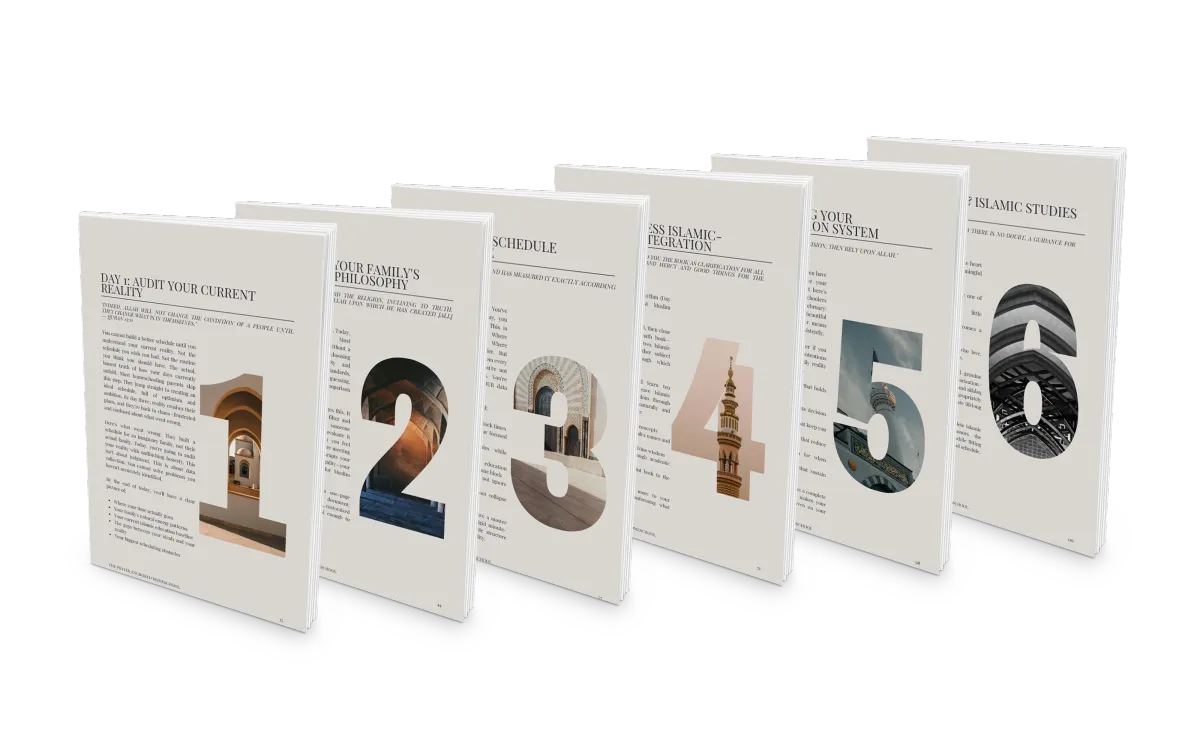
By the end of the 7 days, you will have a clear educational philosophy, a working daily schedule, a plan for integrating Islamic values across all subjects, and a 30-day gradual launch plan so you can begin without overwhelm.
wHAT makes this framework different?
Built on Islam.
Not around it.

Prayer as the Clock
Prayer times become the natural divisions of the day. The structure adapts automatically across seasons — no more seasonal resets or schedule rebuilds.

Integration, Not Competition
Islam is not a separate subject competing for time. It becomes the lens through which all academics are taught — math, science, history all serving deen and dunya together.

Purpose-Based Blocks
The day is organized around energy and intention — not arbitrary time slots. Fajr studies, Core academics, Islamic life skills & Reflection. Each block has a clear purpose.

Reality-First Design
Ramadan, illness, visitors, disruption — all expected, not treated as failure. Emergency modes are built in from the start. This is why the system holds.
How It Works
A step-by-step process
that creates consistency
A step-by-step process that creates continuity

Clarify Your Non-Negotiables
You define what must happen daily and what is optional. This removes decision fatigue and guilt from the start.

Anchor Learning to Prayer
Prayer times become the structure organizing the day. The system naturally adapts as prayer times shift through the year — no seasonal resets.

Build the Four Core Blocks
Each block matches a purpose and energy level. Content fits the family — not the other way around.

Integrate Islam Across Subjects
Ten practical strategies show how deen naturally flows through academics. Nothing forced. Nothing artificial. Learning becomes ibadah.

Create Emergency Modes
Disrupted days still count. Progress continues even when life intervenes. The result is not perfection — it is continuity.
What's Included
Build it once.
Live inside it.
The Prayer Anchored Homeschool ebook
In just 7 days you will gain a clear understanding of the framework, the philosophy behind it, and how to build it for your family. You gain a decision-making filter that ends the daily second-guessing.
Planning & Tracking Tools
Curriculum logs, du'a journal pages, and flexible planning templates. Nothing decorative — every piece reduces friction and keeps progress visible.
Additional Resources to make implementation easier
The Prayer-Anchored Workbook & Sample Schedules help turn concepts into structure, reduce mental load, supports consistency and removes the guesswork.

This framework does not promise ease. It offers coherence. It does not demand intensity. It supports sustainability. If you want a homeschooling structure that honors Islamic life as it actually exists, this framework was built for you.

WHY THIS FRAMEWORK WORKS
The system aligns with well-established principles of learning and behavior
Individualized learning consistently requires less time than institutional schooling.
Faith integrated learning increases engagement and retention
Rhythm-based scheduling reduces burnout and improves follow-through.
Incremental implementation builds habits that last
The framework replaces willpower with structure
It removes false choices
It collapses fragmentation into coherence
That is why families experience relief early and stability over time
FREQUENTLY ASKED Questions
Answers to what you're
already wondering
Answers to what you're already wondering
What if my family situation is complicated?
The framework was designed around complexity, not in spite of it. Day 1 starts with a full audit of your actual life — your prayer times, your energy levels across the day, how many children you have and at what ages, your obstacles, and the gaps between your values and your current reality. You're not asked to fit into a template. You build the template from your own answers. Whether you have a toddler clinging to your leg, a child with learning challenges, a spouse who works nights, or an irregular income that affects your resources, those constraints go into the design, not around it.
I have tried planners and systems before. Why is this different?
Most homeschool planners and systems were designed for secular families and adapted for Muslim use which means prayer, Quran, and Islamic studies are added on top of an existing structure. The result is a schedule that constantly fights itself. This framework inverts that completely. Prayer times are the architecture. The day is divided into four purposeful blocks: Fajr Studies, Core Academics, Islamic Life Skills, and Reflection that shift naturally as prayer times move through the seasons. There is no "Islamic time slot" competing with "school time." Islam is the lens through which everything is taught. The system works because the foundation is different, not just the formatting.
What if I am inconsistent
The system was built with inconsistency in mind because real family life is inconsistent. There is an Emergency Schedule built into the framework which is a stripped-back version of the day you can run when life falls apart. This still counts as a school day and still preserves your most important non-negotiables. There is also a distinction between your core rhythm (what must happen daily) and everything else (which can flex). The goal is not a perfect streak. The goal is that progress continues even on broken days and that you have a clear, low-guilt way back to the rhythm when you fall off it.
Does this require hours of setup?
The setup is structured across 7 days, with each day requiring 2–3 focused hours. You are not asked to do everything at once. Day 1 is observation and audit. Day 2 is philosophy and vision. By Day 3 you are building your actual schedule. By Day 7 you have a gradual 30-day launch plan that starts with just two components and adds the rest incrementally. So in practice, you start seeing relief from the second or third day of building — not after completing the whole thing. The upfront investment is specific and bounded. It is not ongoing. Once the system is built, the daily decision-making it removes is what gives you time back.
What if my children resist?
The framework addresses child resistance directly in Day 7, including a dedicated Resistance Response Protocol in the workbook. Children often resist because transitions are unclear, expectations shift, and the day feels unpredictable to them. When the rhythm is consistent — the same blocks in the same order, anchored to prayers they recognise — children internalise the structure and the resistance reduces. There is also guidance on increasing child buy-in: building in appropriate choice within structure, adjusting lesson length, and distinguishing between a child who is resisting your system and a child who has a learning need that the system needs to accommodate differently.
Is it too late to fix this?
The framework does not require a clean slate. Day 1 takes stock of exactly where you are, not where you should be. The audit worksheets help you identify what is already working (so you keep it), what needs adjusting (so you fix it), and what needs to go entirely (so you stop wasting energy on it). Families who have been homeschooling for years often find the framework easier to implement than complete beginners because they have real data about what does and doesn't work for their children. You do not need to start over. You need to build the right structure underneath what you already have.
The Offer
Begin building alignment
instead of forcing discipline
Begin building alignment instead of forcing discipline
Complete Digital Framework
$17
One-time payment · Instant access · 30-day guarantee
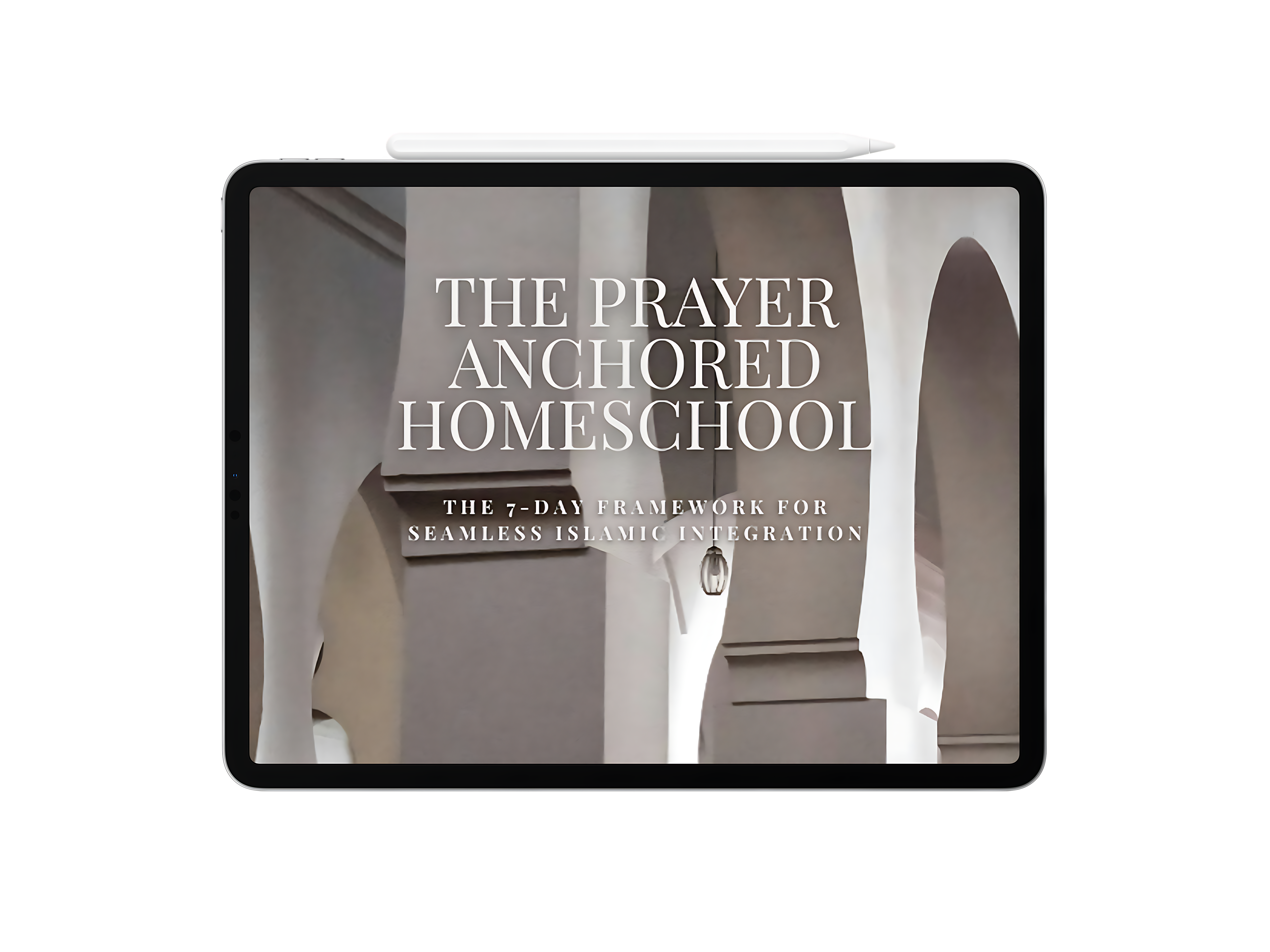
The Prayer Anchored Homeschool — Core Ebook
Complete implementation framework & philosophy
Sample prayer-anchored schedules (5 family types)
Curriculum logs
Flexible planning & tracking templates
Optional Add-on: Full Implementation Workbook (100+ pages)
30-Day Money-Back Guarantee — No Questions Asked
◆ ◆ ◆
Download the system.
Build it once.